
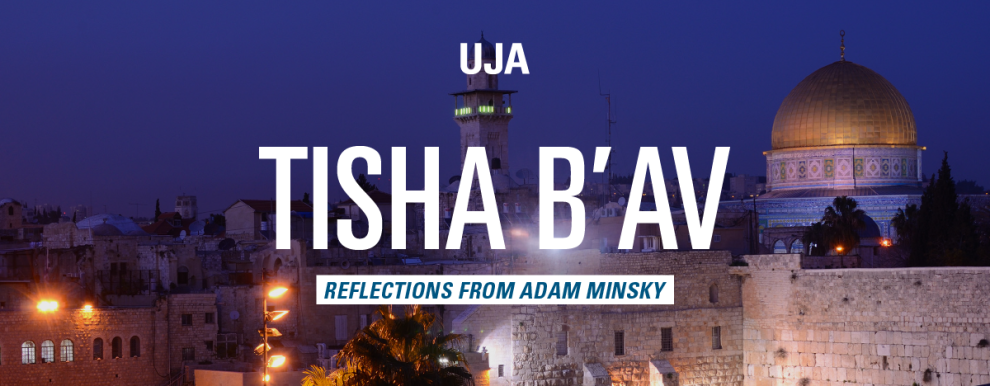
Tonight, the Fast of Tisha B’Av begins. Jews worldwide will start fasting, gather to read the Book of Lamentations, and mourn the destruction of the First and Second Temple.
Tisha B’Av has become linked in the calendar to some of the darkest chapters of Jewish history, including the expulsion of Jews from England (1290) and Spain (1492), as well as the deportation of Jews from the Warsaw Ghetto to the Treblinka death camp (1942).
This historical record helps explain why, in the words of Jerusalem-based Rabbi Nathan Lopes Cardozo, Tisha B’Av has come to be seen as the day when “the Jewish People were transformed into a nation of eternal victims.”
But Tisha B’Av—and what it means to be Jewish—isn’t about victimhood, says Rabbi Cardozo.
Writing just three months before the October 7th massacre, he observed:
If this was true, there would be no purpose to Tisha B’Av. If this is indeed the day all Jews became eternal victims—it would be meaningless to fast, pray and do teshuva (repentance) and ask for the rebuilding of the Temple.
It is essential to recognize that there is a difference between victimization and victimhood. Victimization is the result of external forces. Everyone endures suffering at some stage in his life, for there are external forces we cannot control, and hence, these may cause suffering.
Victimhood, however, is a choice. Victimhood means to choose to become a victim or not. It stems from within; thus, we decide whether we turn ourselves into victims or refuse to do so.
Tisha B’Av is a day of suffering, but under no circumstances a day of victimhood. Jews decided to mourn for the destruction of the Temples only because they assert that on this day the Mashiach (Messiah) will be born and that one day the Temple will be rebuilt—this is not a decision of victims. It is a decision of cognitively-free people.
Jews are eternal survivors because despite victimization they never allowed themselves to descend into the depths of victimhood and become victims.
Reading this passage brings to mind the remarkable Jewish resilience we continue to witness in our own time.
I think of Yoni Finlay, who on Yom Kippur last year barricaded the door of his Manchester synagogue to stop a knife-wielding jihadist. Gunfire from responding police hit Yoni in the chest as he defended the congregation, alongside his friend Adrian Daulby who also courageously blocked the attacker and saved lives. Sadly, the bullet that struck Yoni went on to claim Adrian’s life.
Today, Yoni blames the terrorist rather than the police, saying that the responding officers “ran towards danger to protect us.” After the surgery and trauma, Yoni’s focus as a father of four is on what brought him to synagogue in the first place.
“I think the only way I can get through this is by faith. …For whatever reason, I've been given more time. It comes with the responsibility as well of not wasting that time."
I think of Sheina Gutnick, whose father Reuven Morrison was one of 15 innocents murdered on Bondi Beach. On that horrifying day, it was Reuven who heroically confronted the terrorists with a brick, no doubt knowing that whatever time he bought distracting them would save others.
At that very moment, his daughter Sheina in Melbourne could hear gunshots through her phone. Her mother had called her from Bondi, where she was using her own body to shield a friend. They’re shooting people on the beach—and your father is going after the terrorists, she screamed.
Since then, Sheina hasn’t stopped speaking out to politicians, leaders, and international media, tirelessly campaigning for urgently needed action against Jew hatred. That drive and purpose hasn’t diminished the anguish of a family who will never be whole.
“My kids asked me, ‘Why did Zaida (Grandpa) have to fight?’ I asked them, ‘What do you think, would Zaida hide or fight back?’”
“They looked at me and said, ‘He would fight.’ Even though it is so painful for them that he gave his life, it was a choice he actively made, and he saved lives.”
I think of Rom Braslavski, taken hostage at the Nova Festival where he was working that day. Throughout the attack, Rom calmly and bravely helped evacuate the wounded, and even hid bodies to prevent them from being taken to Gaza. He would endure 738 days of captivity marked by unspeakable torture, abuse, and starvation.
Today, Rom refuses to be broken. Just weeks ago, he was on hand to celebrate the wedding of former hostages Sapir Cohen and Sasha Trufanov, with whom he spent part of his captivity. “We survived by a miracle, brother,” Rom posted on Instagram, along with a picture of himself and Sasha beaming at the wedding. “There’s no one happier than me to accompany you on this day.”
For Rom, life is a daily battle with severe PTSD, but that doesn’t stop him from sharing his message with the world and living with gratitude to God for his survival.
“They win and I do not if I sink into depression and sadness. That’s not something I’m willing to accept. Every day I choose again: to open the shutters, get up early, and let the sunlight into my life. I let the sun illuminate my dark face. It’s dark inside, but bright outside…”
Yoni Finlay. Sheina Gutnick. Rom Braslavski. And many more throughout our Jewish world today with painfully similar stories.
Proud Jews who lived ordinary lives, until the day it all changed. Victimized but never accepting victimhood.
On Tisha B’Av, we mourn and remember what we have lost. But we never stop there.
Because as these extraordinary individuals and so many others have shown us, that isn’t the Jewish way.
I wish all who are observing a safe and meaningful fast,
Adam Minsky
President & CEO
UJA Federation of Greater Toronto